Steve Jobs remains one of the most influential entrepreneurs in modern history. As the co-founder of Apple Inc., he transformed personal computing, smartphones, music, and animation through groundbreaking innovation and visionary leadership. From launching the Apple I in a garage to introducing the iPhone and leading one of the world’s most valuable companies, Jobs built a legacy that changed global technology forever.
Although Steve Jobs passed away in 2011, his financial legacy continues to attract global attention. As of 2026, Steve Jobs net worth is historically estimated at around $10.2 billion at the time of his death, while the value of his holdings and family wealth linked to his investments has grown significantly over time. His fortune came from Apple shares, his investment in The Walt Disney Company through Pixar, and strategic long-term ownership.
In this article, we explore Steve Jobs net worth, wealth growth, income sources, assets, business strategy, and lasting financial impact.
Bio Data Table
| Attribute | Information |
|---|---|
| Full Name | Steven Paul Jobs |
| Popular Name | Steve Jobs |
| Date of Birth | February 24, 1955 |
| Date of Death | October 5, 2011 |
| Age at Death | 56 Years |
| Birthplace | San Francisco, California, USA |
| Nationality | American |
| Profession | Entrepreneur, Inventor, Businessman |
| Famous For | Co-founder of Apple Inc. |
| Education | Reed College (Dropped Out) |
| Spouse | Laurene Powell Jobs |
| Children | 4 |
| Major Companies | Apple Inc., Pixar, NeXT |
| Main Income Sources | Apple Shares, Pixar Sale, Investments |
| Estimated Historical Net Worth | $10.2 Billion |
| Industry | Technology |
| Legacy Status | One of the Greatest Tech Visionaries |
Who Is Steve Jobs?
Steve Jobs was born on February 24, 1955, in San Francisco, California. He was adopted shortly after birth by Paul and Clara Jobs, who raised him in Silicon Valley, where his interest in electronics and innovation began early.
As a teenager, Jobs became fascinated by technology and engineering. He attended Reed College but dropped out after only one semester. However, leaving formal education did not stop his learning. He continued auditing classes that interested him, especially calligraphy, which later influenced Apple’s design philosophy.
In 1976, Steve Jobs co-founded Apple with Steve Wozniak and Ronald Wayne. Their goal was simple: make computers accessible to everyday people. That small startup eventually became one of the most valuable companies in history.
Jobs’ early vision, combined with relentless perfectionism, built the foundation for extraordinary wealth and global influence.
Net Worth Overview
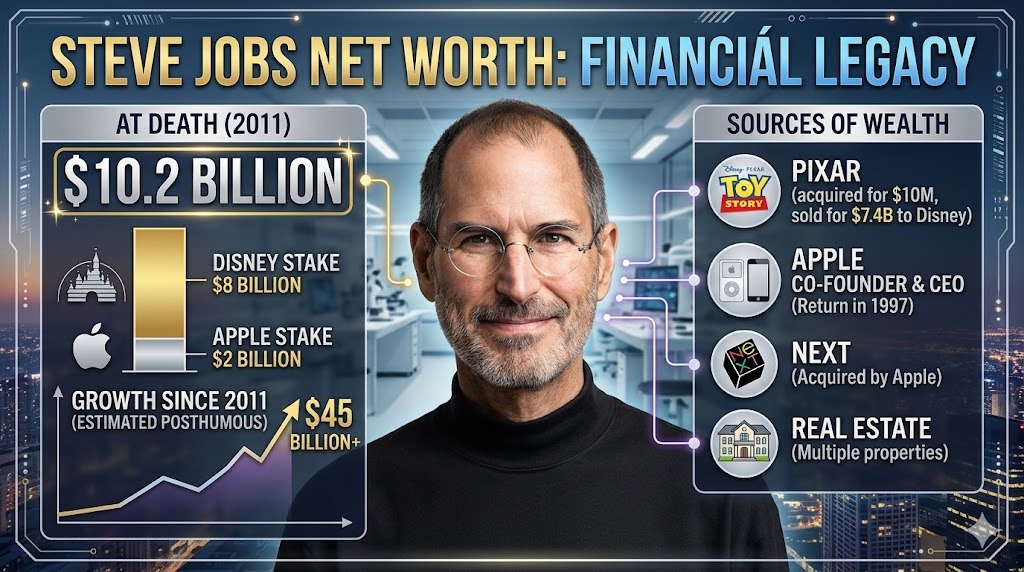
At the time of his death in 2011, Steve Jobs’ net worth was estimated at approximately $10.2 billion. Interestingly, most of this wealth did not come directly from Apple stock. Instead, a major portion came from Pixar, the animation studio he purchased and later sold to Disney.
Jobs owned roughly 7% of Disney after Pixar was acquired by Disney in 2006, making him Disney’s largest individual shareholder at the time. This investment significantly increased his fortune and diversified his wealth beyond Apple.
Unlike many billionaires, Jobs held relatively few Apple shares because he sold most of them earlier in his career. However, his business ownership strategy and investment discipline created one of the strongest financial legacies in tech history.
Steve Jobs Net Worth Growth Table
| Year | Estimated Net Worth |
|---|---|
| 1985 | $250 Million |
| 1995 | $500 Million |
| 2000 | $4 Billion |
| 2005 | $5.5 Billion |
| 2010 | $8.3 Billion |
| 2011 | $10.2 Billion |
| 2026 Legacy Value | Multi-Billion Family Wealth |
This growth reflects his success across Apple, Pixar, and strategic ownership.
Net Worth Growth Timeline
Before Fame
Before Apple became successful, Steve Jobs worked at Atari and lived a simple lifestyle focused on creativity and experimentation. His early income was minimal, but his vision was already powerful.
Breakthrough Phase
The launch of the Apple II made Apple a major success and turned Jobs into a millionaire before the age of 25. His breakthrough came from innovation and product ownership, not salary alone.
Peak Career Years
Returning to Apple in 1997 changed everything. The iMac, iPod, iPhone, and iPad transformed Apple into a global giant. During this phase, his influence and wealth grew rapidly.
Final Years
By 2011, Jobs had become one of the richest and most respected entrepreneurs in the world. His Disney shares and Apple leadership cemented his billionaire status.
Main Sources of Income
Core Profession Income
Steve Jobs earned wealth primarily through company ownership, not executive salary. His famous annual salary at Apple was just $1, but his real fortune came from equity ownership and long-term appreciation.
Apple Ownership
Apple shares created enormous wealth through capital growth. Even though he did not retain massive holdings later, Apple’s success defined his financial legacy.
Pixar and Disney Revenue
Jobs purchased Pixar from Lucasfilm and turned it into a global animation powerhouse. When Disney acquired Pixar, his Disney stake became a major source of wealth.
Investments and Business Revenue
His ownership in NeXT and other ventures also added to his fortune, proving that strategic investments were central to his financial success.
Business Strategy Behind the Wealth
Steve Jobs believed in ownership over salary. Rather than focusing on executive compensation, he focused on building valuable companies and controlling innovation.
His strategy emphasized:
- Equity ownership
- Product excellence
- Long-term vision
- Brand dominance
- Intellectual property value
This ownership-first mindset created far greater wealth than traditional salary-based success.
Jobs also avoided over-diversification and focused deeply on a few high-impact ventures.
Awards & Achievements and Financial Impact
Steve Jobs received numerous honors, including:
- National Medal of Technology
- Grammy Trustees Award
- Fortune’s Greatest Entrepreneur Recognition
- Presidential Medal of Freedom (posthumous)
- Multiple innovation and leadership awards
These achievements strengthened both his market credibility and company valuation, increasing investor confidence and long-term wealth creation.
Assets & Lifestyle
Real Estate
Steve Jobs owned luxury properties in California, including his famous home in Palo Alto. His real estate portfolio reflected elegance and simplicity rather than excessive luxury.
Cars & Luxury
Jobs was known for driving luxury cars like the Mercedes-Benz SL55 AMG, but he generally preferred minimalism over flashy spending.
Fashion & Investments
His iconic black turtleneck, jeans, and sneakers symbolized simplicity. Rather than luxury fashion, Jobs invested heavily in business growth and ownership.
Net Worth Comparison (Peers / Industry)
Compared to tech leaders like Bill Gates, Jeff Bezos, and Elon Musk, Steve Jobs’ personal net worth was smaller.
However, his influence on global technology and wealth creation was arguably greater. He built products that reshaped entire industries.
Controversies, Challenges & Financial Risks
Jobs faced major professional setbacks, including being removed from Apple in 1985. This was both a personal and financial challenge.
He also battled serious health issues, including pancreatic cancer, which affected his later career years.
Despite setbacks, his ownership in Pixar and eventual return to Apple protected and expanded his fortune significantly.
Philanthropy & Social Impact
Unlike many billionaires, Jobs kept philanthropy relatively private. However, his wife, Laurene Powell Jobs, became a major philanthropist through the Emerson Collective.
His greatest social impact may be technological transformation itself—changing education, communication, healthcare, and creativity worldwide.
How Steve Jobs Makes Money Outside Core Profession
Outside Apple, Steve Jobs built wealth through:
- Pixar ownership
- Disney shareholding
- NeXT acquisition
- Strategic investments
- Licensing and intellectual property value
These passive wealth streams created long-term financial power far beyond salary.
Future Net Worth Projection
Although Steve Jobs is no longer alive, the value of his legacy remains enormous. His family wealth tied to Disney shares, investments, and ownership structures continues to grow.
By 2026, the broader financial legacy connected to Steve Jobs remains worth multiple billions, and his influence on wealth creation continues through Apple’s global dominance.
His name remains one of the most valuable brands in business history.
Frequently Asked Questions
What was Steve Jobs net worth when he died?
Steve Jobs’ net worth was estimated at around $10.2 billion in 2011.
Did Steve Jobs get rich from Apple?
Partly yes, but much of his wealth came from Pixar and Disney shares rather than Apple stock alone.
Why did Steve Jobs only take a $1 salary?
He believed ownership mattered more than salary. His wealth came from equity, not annual pay.
Who inherited Steve Jobs’ fortune?
Most of his wealth went to his wife, Laurene Powell Jobs, and his family.
Was Steve Jobs richer than Bill Gates?
No, Bill Gates had a significantly higher personal net worth, but Jobs had massive industry influence.
Conclusion
Steve Jobs created one of the greatest financial and technological legacies in history. With a historical net worth of $10.2 billion, he proved that ownership, innovation, and long-term vision create extraordinary wealth. From Apple to Pixar and Disney, Jobs built more than fortune—he built a global legacy. Steve Jobs net worth remains a symbol of entrepreneurial brilliance, business discipline, and world-changing leadership.