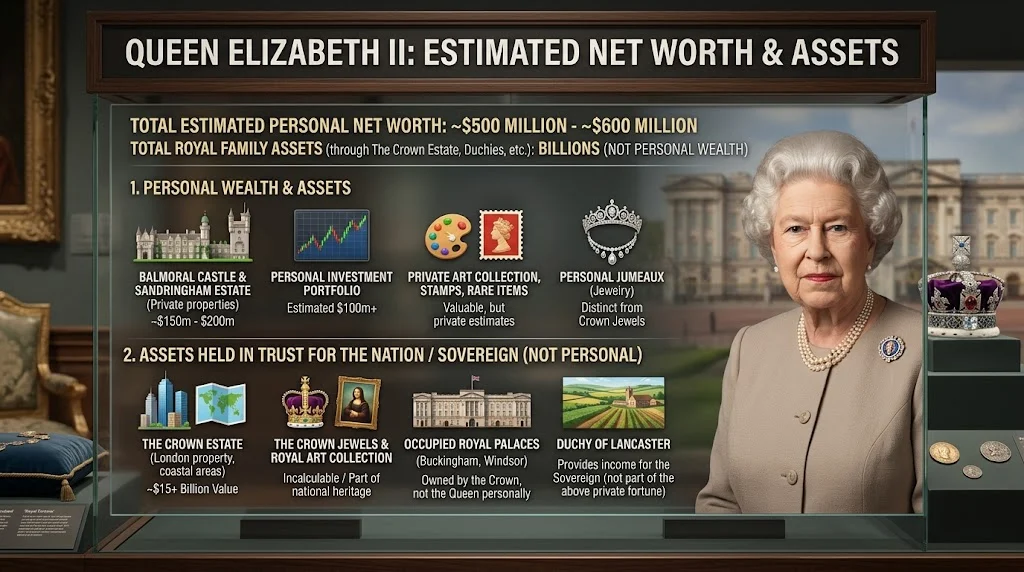
Queen Elizabeth II was one of the most influential and recognizable figures in modern history. As the longest-reigning monarch in British history, she spent more than seven decades on the throne and became a symbol of stability, tradition, and leadership. Beyond her royal duties, many people remain curious about Queen Elizabeth net worth, the wealth she accumulated during her lifetime, and the vast assets associated with the British monarchy.
At the time of her passing in 2022, Queen Elizabeth II was widely regarded as one of the wealthiest royals in the world. Her personal fortune included private estates, investments, valuable collections, and inherited wealth. Even years after her death, public interest in her financial legacy remains strong. As of 2026, estimates place Queen Elizabeth II’s personal net worth at approximately $500 million to $600 million, excluding many assets owned by the Crown rather than the monarch personally.
This article explores Queen Elizabeth’s wealth, income sources, assets, royal holdings, and the financial legacy she left behind.
Bio Table of queen Elizabeth net worth
| Attribute | Details |
|---|---|
| Full Name | Elizabeth Alexandra Mary Windsor |
| Popular Name | Queen Elizabeth II |
| Date of Birth | April 21, 1926 |
| Age (Would Be in 2026) | 100 Years |
| Place of Birth | London, England |
| Nationality | British |
| Height | 5 Feet 4 Inches (163 cm) |
| Weight | Approximately 58 kg (128 lbs) |
| Health Conditions | Age-related health issues during later years |
| Religion | Christianity (Church of England) |
| Education | Private Royal Education |
| Sports | Horse Riding, Horse Racing |
| Zodiac Sign | Taurus |
| Marriage Status | Widowed |
| Husband | Prince Philip |
| Children | Charles, Anne, Andrew, Edward |
| Net Worth | $500–600 Million (Estimated Personal Wealth) |
| Source of Wealth | Royal Assets, Investments, Estates |
| Social Media Accounts | Official Royal Family Accounts |
| Still Alive | No |
| Famous For | Longest-Reigning British Monarch |
| Years as Monarch | 1952–2022 |
Who Was Queen Elizabeth II? (Background & Early Life)
Queen Elizabeth II was born on April 21, 1926, in London. At the time of her birth, she was not expected to become queen. However, a series of events within the royal family ultimately placed her first in line to the throne.
She was educated privately and received training in constitutional history, languages, and state affairs. During World War II, she served in the Auxiliary Territorial Service, becoming the first female member of the royal family to serve in the armed forces.
In 1947, she married Prince Philip. Their marriage lasted more than 70 years and became one of the most enduring royal relationships in history.
After the death of her father, King George VI, in 1952, Elizabeth became Queen of the United Kingdom at just 25 years old.
Her reign would eventually span seven decades and witness enormous political, social, and economic changes across the world.
Net Worth Overview (2026 Estimate)
Queen Elizabeth II’s estimated personal net worth is believed to have been between $500 million and $600 million.
It is important to distinguish between:
Personal Wealth
Assets personally owned by Queen Elizabeth included:
- Private investments
- Sandringham Estate
- Balmoral Castle
- Valuable jewelry collections
- Art collections
- Cash holdings
- Horse breeding interests
Crown Assets
Many people mistakenly assume that all royal properties belonged personally to the Queen. In reality, several valuable assets are owned by the Crown and passed automatically to future monarchs.
Examples include:
- Buckingham Palace
- Windsor Castle
- Crown Estate holdings
- Crown Jewels
These assets are not included in estimates of Queen Elizabeth’s personal net worth.
Queen Elizabeth Net Worth Growth Timeline
Early Royal Years
Before becoming queen, Elizabeth’s personal wealth was relatively modest compared with later years. Most resources came from royal family support and inherited wealth.
Estimated Net Worth: Under $10 Million
Becoming Queen
Following her accession to the throne in 1952, her financial position strengthened significantly through royal allowances, inherited assets, and investment growth.
Estimated Net Worth (1960s): $50 Million+
Mid-Reign Expansion
Over the following decades, the Queen’s private wealth expanded due to:
- Estate appreciation
- Investment growth
- Valuable collections
- Agricultural revenues
Estimated Net Worth (1990s): $200 Million+
Final Years
By the final decade of her life, Queen Elizabeth’s wealth had increased substantially.
Estimated Net Worth (2022): $500–600 Million
Net Worth Growth Table
| Year | Estimated Net Worth |
|---|---|
| 1952 | $10 Million |
| 1970 | $80 Million |
| 1990 | $200 Million |
| 2000 | $350 Million |
| 2010 | $450 Million |
| 2022 | $500–600 Million |
| 2026 Legacy Estimate | $500–600 Million |
Main Sources of Income
Royal Income
Throughout her reign, Queen Elizabeth received income associated with royal responsibilities and estate management.
Although many royal finances are complex, various funding mechanisms supported the monarchy’s operations.
Investment Portfolio
One of the most significant contributors to her wealth was a carefully managed investment portfolio.
Financial analysts have long suggested that the Queen held substantial investments in:
- Blue-chip stocks
- Real estate assets
- Private funds
- Long-term holdings
These investments generated consistent growth over many decades.
Sandringham Estate
Sandringham House was one of the Queen’s privately owned estates.
The property generated revenue through:
- Agriculture
- Tourism
- Events
- Property management
As a private asset, it formed a significant part of her personal fortune.
Balmoral Castle
Another important personal asset was Balmoral Castle.
The estate includes thousands of acres of land and has substantial historical and financial value.
Business Strategy Behind the Wealth
Although Queen Elizabeth II was not a businesswoman in the traditional sense, she oversaw a vast portfolio of assets and investments throughout her reign. One of the key reasons her wealth remained stable for decades was the careful management of royal properties, agricultural estates, and financial investments.
The Queen worked closely with professional advisors who helped manage her personal fortune. Rather than pursuing risky ventures, her wealth strategy focused on long-term asset appreciation and preservation. This conservative approach ensured that her fortune continued growing while protecting it from significant financial losses.
Several factors contributed to the growth of her wealth:
- Long-term investment planning
- Ownership of valuable private estates
- Appreciation of land and property values
- Revenue from tourism and estate operations
- Careful financial management
This strategy helped transform inherited assets into a fortune worth hundreds of millions of dollars.
Awards, Achievements and Their Financial Impact
Queen Elizabeth II’s achievements were historic. She became the longest-reigning monarch in British history and one of the most respected leaders in the world.
Some of her most notable achievements include:
Longest-Reigning British Monarch
Her 70-year reign established a record in British history and significantly enhanced the global value of the royal brand.
International Influence
She met numerous world leaders, presidents, and prime ministers throughout her reign, strengthening diplomatic relationships worldwide.
Commonwealth Leadership
The Queen played a crucial role in maintaining relationships among Commonwealth nations.
Global Recognition
Her image became one of the most recognized symbols on Earth, appearing on currency, stamps, and official government materials across multiple countries.
These achievements increased public interest in the monarchy, indirectly contributing to the financial value of royal properties, tourism, and related assets.
Assets and Lifestyle
Queen Elizabeth lived a life of privilege, but she was often described as practical and disciplined when it came to personal spending.
While she had access to some of the world’s most valuable residences and collections, she was known for maintaining traditions and avoiding excessive displays of luxury.
Her wealth was concentrated primarily in:
- Real estate
- Jewelry collections
- Art collections
- Investments
- Agricultural estates
- Horses and breeding operations
Real Estate Portfolio
Real estate represented one of the most valuable components of Queen Elizabeth’s personal fortune.
Balmoral Castle
Located in Scotland, Balmoral Castle was privately owned by the Queen rather than the Crown.
The estate includes:
- Thousands of acres of land
- Forests and farmland
- Historic buildings
- Tourist attractions
The property’s value is estimated in the tens of millions of dollars.
Sandringham Estate
The Sandringham Estate in Norfolk was another privately owned royal property.
The estate generates income through:
- Farming operations
- Tourism activities
- Property rentals
- Special events
Its historical significance and extensive land holdings make it one of Britain’s most valuable private estates.
Additional Properties
While many royal residences belong to the Crown Estate, the Queen also possessed private property interests and inherited assets that contributed to her overall wealth.
Jewelry Collection
One of the most fascinating aspects of Queen Elizabeth’s wealth was her extraordinary jewelry collection.
The collection included:
- Rare diamonds
- Emeralds
- Rubies
- Sapphires
- Pearls
- Historic royal pieces
Many of these items were inherited from previous monarchs and accumulated over generations.
Experts estimate that portions of the royal jewelry collection are worth hundreds of millions of dollars.
However, not all jewelry was considered part of her personal estate. Some pieces belonged to the Crown and were held in trust for future monarchs.
Art Collection and Valuable Possessions
Throughout her lifetime, Queen Elizabeth possessed access to one of the world’s most significant art collections.
The Royal Collection includes:
- Paintings by famous masters
- Historical artifacts
- Rare manuscripts
- Decorative arts
- Antique furniture
Although much of the collection belongs to the monarchy rather than the monarch personally, it reflects the immense cultural and financial value associated with the royal family.
The total value of the Royal Collection is estimated in the billions of dollars.
Horse Racing and Breeding Interests
Queen Elizabeth had a lifelong passion for horses.
Horse racing and breeding were not merely hobbies; they also represented a significant investment.
Her racing operations included:
- Thoroughbred breeding
- Racehorse ownership
- Agricultural activities
- Prize winnings
Over the years, her horses won numerous prestigious races, generating income and enhancing the reputation of the royal breeding program.
Net Worth Comparison
Queen Elizabeth’s personal fortune was substantial, but it was smaller than many people assumed due to confusion between personal assets and Crown property.
Comparison With Other Royals
| Royal Figure | Estimated Net Worth |
|---|---|
| Queen Elizabeth II | $500–600 Million |
| King Charles III | $700 Million+ |
| Prince William | $100 Million+ |
| Prince Harry | $60–80 Million |
| Prince Andrew | $10–20 Million |
Comparison With Global Billionaires
Although wealthy, Queen Elizabeth’s personal fortune was significantly lower than that of major billionaires such as technology founders and business magnates.
This distinction highlights the difference between personal wealth and the enormous institutional wealth associated with the British monarchy.
Controversies, Challenges and Financial Risks
No public figure enjoys a lengthy career without facing challenges, and Queen Elizabeth was no exception.
Royal Family Controversies
Over the decades, the monarchy faced various public relations difficulties involving members of the royal family.
These events occasionally affected public perceptions and generated debate regarding royal finances.
Economic Recessions
The Queen’s investments and estate operations experienced the effects of economic downturns, including global recessions and financial crises.
However, diversification helped protect her wealth from major losses.
Changing Public Attitudes
The role of the monarchy evolved significantly during her reign. Public expectations regarding transparency and accountability increased, creating new challenges for royal finances.
Despite these pressures, Queen Elizabeth maintained strong public support throughout most of her reign.
Philanthropy and Social Impact
Queen Elizabeth dedicated much of her life to charitable work.
She served as patron of hundreds of organizations, supporting causes such as:
- Education
- Healthcare
- Youth development
- Military families
- Environmental conservation
- Arts and culture
Her influence helped raise awareness and funding for numerous charitable initiatives around the world.
Although philanthropy did not increase her net worth, it strengthened her legacy and global reputation.
How Queen Elizabeth Made Money Outside Royal Duties
Beyond official royal responsibilities, Queen Elizabeth generated income through several privately owned assets.
Private Estates
Both Sandringham and Balmoral generated revenue through tourism, agriculture, and property management.
Investments
Her diversified investment portfolio produced long-term returns.
Horse Breeding
The royal racing operation generated earnings through racing success and breeding activities.
Agricultural Operations
Large portions of her land were used for farming and livestock activities, creating additional revenue streams.
These income sources contributed significantly to her personal fortune over the years.
Financial Legacy After Her Death
Following Queen Elizabeth’s passing in 2022, many of her private assets were inherited by her successor, King Charles III.
The transfer of wealth ensured continuity within the royal family while preserving important historical properties.
Her financial legacy includes:
- Private estates
- Investments
- Valuable collections
- Historical assets
Even in 2026, her wealth and influence continue to shape discussions about the monarchy’s finances.
Future Value of Queen Elizabeth’s Legacy
Although Queen Elizabeth is no longer alive, the historical and cultural significance of her legacy continues to grow.
Her properties, collections, and historical importance are likely to appreciate in value over time.
Future generations will continue studying her reign, making her one of the most influential and financially significant royal figures in modern history.
Frequently Asked Questions
What was Queen Elizabeth’s net worth when she died?
Her personal net worth was estimated at approximately $500 million to $600 million.
Did Queen Elizabeth own Buckingham Palace?
No. Buckingham Palace is owned by the Crown and not considered her personal property.
What were Queen Elizabeth’s most valuable personal assets?
Her most valuable personal assets included Balmoral Castle, Sandringham Estate, investments, jewelry, and horse breeding interests.
Who inherited Queen Elizabeth’s wealth?
Many of her personal assets were inherited by King Charles III.
Was Queen Elizabeth a billionaire?
No. Despite common assumptions, her personal fortune was generally estimated below one billion dollars.
Is Queen Elizabeth still alive?
No. Queen Elizabeth II passed away on September 8, 2022.
Conclusion
Queen Elizabeth II remains one of the most influential figures in modern history. With an estimated personal net worth of $500 million to $600 million, she accumulated substantial wealth through private estates, investments, agricultural operations, and valuable collections. While many assets associated with the monarchy belonged to the Crown rather than the Queen personally, her financial legacy remains remarkable.
Her 70-year reign brought stability, tradition, and global recognition to the British monarchy. Even years after her passing, interest in Queen Elizabeth net worth, royal assets, and her enduring legacy continues to captivate people around the world. Her wealth was not only measured in financial terms but also in the historical and cultural impact she left behind.
Discover More Post
846+Troll Puns So Clever They Deserve a Bridge For 2026
Kirby Puns So Cute They’ll Inhale Your Funny Bone in 2026